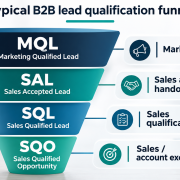
MQL vs SQL vs SQO: What Actually Counts as a Qualified B2B Lead? (UK 2026 Guide)
An MQL (marketing qualified lead) is a contact whose behaviour and profile suggest they could buy. An SQL (sales qualified lead) is a lead that a salesperson has spoken to and agreed is worth pursuing. An SQO (sales qualified opportunity) is an SQL that has passed a formal discovery conversation and is now a forecastable deal in your CRM. Each label marks a different handover, and most pipeline arguments between sales and marketing come from teams using the same word for different things.
What Is the Difference Between an MQL, an SQL and an SQO?
An MQL is a contact who has engaged with your marketing and matches your ideal customer profile (ICP), but has not yet spoken to sales. An SQL is a prospect that sales, usually an SDR or appointment setter, has vetted through two-way conversation and confirmed as worth active pursuit. An SQO is an SQL that has cleared a standard qualification gate in discovery and become an active, forecastable opportunity.
| Stage | Who decides | Evidence required | What happens next |
|---|---|---|---|
| MQL | Marketing (scoring rules) | Engagement plus ICP fit, for example a director-level title and a pricing page visit | Passed to sales or an SDR/telemarketing team for a call |
| SAL (optional) | Sales | Sales has reviewed the MQL and agreed to work it | Outreach begins |
| SQL | Sales, by speaking to the lead | Two-way conversation, confirmed need and ICP fit | Meeting booked with an account executive |
| SQO | Account executive, after discovery | ICP fit, pain, budget, decision-maker engaged, next step scheduled | Opportunity created in CRM and forecast |
What Is a Marketing Qualified Lead (MQL)?
A marketing qualified lead is a contact who has shown enough interest and fit to justify a sales conversation. The signals are usually a blend of who they are (job title, company size, sector) and what they have done (downloaded a guide, attended a webinar, visited a pricing page). A typical scoring model might add points for a director-level title, webinar attendance and a pricing page visit.
The weakness of MQLs is that they measure interest, not readiness. Someone who downloads a white paper may be a student, a competitor or a buyer 18 months from a decision. That is why an MQL should never be reported to the board as a sales lead.
What Is a Sales Qualified Lead (SQL)?
A sales qualified lead is a lead a salesperson has actually spoken to and agreed is worth pursuing. The important word is spoken. An SQL is created by a conversation, not a score. Some teams add a middle step, the sales accepted lead (SAL), where sales formally accepts an MQL before any outreach, but many UK B2B teams skip it and move straight from MQL to a call.
This is the stage where phone-based qualification earns its keep. A trained caller can confirm in a few minutes whether there is a genuine need, whether the person holds budget or influence, and whether the timing is realistic. That is the core of what we do in our B2B appointment setting service, and it is why the SQL definition should be agreed with your telemarketing partner before the first call is made.
What Is a Sales Qualified Opportunity (SQO)?
A sales qualified opportunity is an SQL that an account executive has taken through discovery and confirmed against a fixed checklist. A common five-point test is: ICP fit, a real business pain, budget, a decision-maker engaged, and a scheduled next step. If any of the five is missing, the lead stays an SQL.
The SQO is the first stage you can sensibly forecast. Revenue forecasts built on MQLs or even SQLs will swing wildly, because too many of them never become real deals.
Why Do the Definitions Matter So Much?
Because the same word means different things in different companies. Public benchmarks illustrate the problem: one agency analysis notes that two companies in the same vertical can report conversion rates of 13% and 42% from MQL to SQL, simply because they define the terms differently (Understory Agency, 2026). A team that counts any sales call as an SQL will look far healthier than one that requires a booked meeting, yet generate the same revenue.
If you outsource lead generation, a vague definition is expensive. An agency paid per “qualified lead” will naturally lean toward the loosest reading.
What Are Typical MQL to SQL to SQO Conversion Rates?
Benchmarks vary widely by sector, source and definition, so treat any figure as a sense-check rather than a target. The most cited public dataset comes from First Page Sage, which reports an average B2B SaaS MQL to SQL rate of 13% (client data, 2019 to 2025) and an SQL to closed-won rate of around 12% (February 2025), both as reported by Understory Agency. Its sector table, as reproduced by Prospeo, puts cybersecurity at 15%, fintech at 11% and engineering at 11%.
| Step | Commonly quoted range | Source and caveat |
|---|---|---|
| MQL to SQL | About 13% average for B2B SaaS; 11% to 15% for tech-adjacent sectors | First Page Sage, 2019 to 2025 client data |
| MQL to SQL (vendor rule of thumb) | 20% to 40% | Callbox comparison table, no source named |
| SQL to SQO (inbound) | 30% to 50% | Callbox, no source named |
| SQO to closed-won | 15% to 30% | Callbox, no source named |
| SQL to closed-won | Around 12% for B2B SaaS | First Page Sage, February 2025 |
Notice the gap between the 13% dataset average and the 20% to 40% vendor range. Neither is wrong; they measure different things. The honest takeaway is to benchmark against your own history first, and to use published figures only to spot a stage that looks unusually weak.
How Fast Should You Follow Up an MQL?
As fast as you can. Harvard Business Review research from 2011, covering 1.25 million leads, found that firms that tried to contact a lead within an hour were nearly seven times as likely to reach a key decision-maker as firms that waited a further hour, and more than 60 times as likely as those that waited 24 hours or more. The research covered US companies, but the principle holds in the UK: interest decays quickly, and a lead that is warm today is a cold call next week.
How Do You Agree What Counts as Qualified?
Write it down, in plain language, and get sales, marketing and any outsourced team to sign it off. A workable process looks like this:
- Define the ICP. Sector, company size, geography, job titles and the problem you solve.
- Set the MQL threshold. Which behaviours and attributes trigger a handover, and what happens to leads that fall short.
- Set the SQL standard. The minimum a caller must confirm: need, authority, timing and a willingness to meet. Decide whether a booked meeting is required.
- Set the SQO gate. The checklist an account executive completes in discovery before an opportunity is created.
- Agree service levels. How quickly each handover must be actioned, and what feedback sales owes back on rejected leads.
- Review monthly. Look at the stage-to-stage conversion and adjust the definitions, not the reporting.
Clean contact data underpins every stage, because a score or a call is only as good as the record behind it.
Which Channels Produce SQLs Rather Than Just MQLs?
Channels that involve a live conversation tend to create SQLs faster, because the qualification happens during the contact itself. Phone is the clearest example: a trained caller can move a target account from unknown to SQL in a single call. LinkedIn and email usually generate replies that still need a conversation to qualify.
Common Mistakes When Using MQL, SQL and SQO
- Counting MQLs as pipeline. They are marketing activity, not sales opportunities.
- Letting the agency define “qualified”. Always supply your own written criteria.
- Skipping feedback. If sales never explains why a lead was rejected, the scoring never improves.
- Measuring volume instead of conversion. Fifty weak SQLs are worth less than ten leads that become SQOs.
- Creating opportunities too early. An inflated SQO count ruins forecast accuracy.
How Prospect Solutions Can Help
Prospect Solutions is an ICO registered B2B telemarketing specialist. We agree your SQL definition up front, qualify prospects by phone against it, and hand over only the conversations your sales team would actually want to take. Explore our appointment setting service and B2B lead generation service, or talk to our team about defining and delivering qualified leads for your market.
Frequently Asked Questions
What is the difference between an MQL and an SQL?
An MQL is qualified by marketing based on engagement and fit. An SQL is qualified by sales through a direct conversation. The SQL is the first stage at which a human has confirmed genuine interest.
What is an SQO in sales?
An SQO is a sales qualified opportunity: an SQL that has passed a formal discovery stage and become an active, forecastable deal in the CRM.
Is an SQL the same as an opportunity?
No. An SQL is a qualified lead. An opportunity (SQO) is created only after discovery confirms fit, pain, budget, authority and a next step.
What is a good MQL to SQL conversion rate?
The most cited public average is about 13% for B2B SaaS, according to First Page Sage data, though vendors quote 20% to 40%. Your own historical rate is the better benchmark.
What is a SAL?
A sales accepted lead is an MQL that sales has reviewed and agreed to work. It is an optional step between MQL and SQL.
Who should qualify leads, marketing or sales?
Marketing qualifies MQLs by scoring. Sales, or a specialist telemarketing team acting for sales, qualifies SQLs by conversation. Account executives qualify SQOs in discovery.